Quantum Field Theory
Quantum Field Theory is a framework that applies quantum principles to the classical theory of fields. It treats particles as quantized excitations of continuous fields defined over space-time. Interactions occur through local couplings of these fields, replacing classical point particles with operator-valued functions. QFT respects both quantum mechanics and special relativity. It ensures causality by demanding that field operators commute at spacelike separations. This framework forms the basis of the Standard Model of particle physics.
Notes
- Why is cross section 2D? — short PDF note

Session 1
Introduction to QFT, mostly focusing on when do we need the migration from regular quantum mechanics to quantum field theory.

Session 2
This section focuses on the concept of symmetry and conserved currents which is known as Noether's theorem.

Session 3
This session focuses on the concept of "Quantization" and how to transform classical ideas to "Hilbert space" to be able to have a quantum description.

Session 4
This session focuses on the concept of "Causality" and propagator, and the idea that the Klein-Gordon field can solve the causality problem in relativistic particle quantum mechanics.

Session 5
This session is about Dirac algebra in the classical Dirac equation. It is an introduction to how anti-commuting nature can be introduced to the classical fields.

Session 6
In this session we will see how to write down a "representation" of a Lorentz transformation in spinor space. We see how momentum boost and rotation in spinor space are interconnected, and how the concept of spin can naturally be incorporated within the field.

Session 7
This session is about the connection of angular momentum and spin and how the total angular momentum is defined out of both of them. We also talk about the concept of a field defined on a manifold and how it transforms through the geometry of the manifold. We explain how spin is different from a regular object that rotates under SO(1,3) and how spin is like a Möbius band defined object.
Session 8
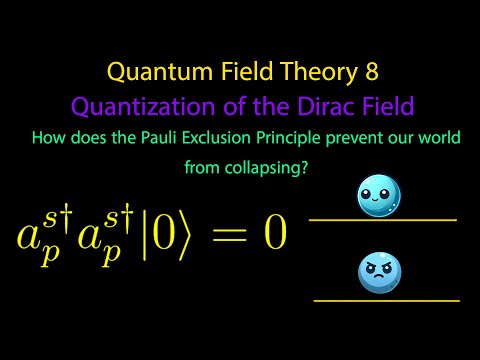
In this session, we focus on the anticommutator algebra and the meaning of fermions with respect to bosons. The Pauli exclusion principle naturally emerges from the Dirac algebra. This principle states that no two identical fermions can occupy the same quantum state simultaneously. It explains the structure of electron shells in atoms and underlies the stability of matter. In contrast, bosons obey commutation relations and can occupy the same state, leading to phenomena like Bose-Einstein condensation.

Session 9
This video explains how to calculate the Dirac propagator using the Green's function method, a technique rooted in classical theory. It walks through each step of setting up the problem in the context of quantum field theory. The use of Green's functions helps translate differential equations into solvable integral forms. A major part of the process involves evaluating complex integrals that appear naturally in the formalism. The video applies the residue theorem from complex analysis to perform these calculations.

Session 10
In this video we discuss three forms of discrete symmetries which are different in nature from continuous transformations like translation, rotation or boost. We introduce the concept of parity to categorize two types of behavior under parity, odd or even parity. We also talk about the combination of these symmetries and how the weak interaction violates CP symmetries while the two other interactions, QED and QCD, do not violate CP.

Session 11 — Perturbative Interactions
In this video we explore the concept of perturbative interactions and the philosophy behind them. For the first time, we demonstrate how to express these interactions using creation and annihilation operators, showing that all processes can ultimately be reduced to these fundamental operations.

Session 12 — Free Vacuum vs Interacting Vacuum
In this video we explain how to calculate the evolution of fields when interaction is present. The approach begins with free fields, where the description is simple and the vacuum is called the free vacuum. From this starting point we introduce the idea of perturbation: we take the known results of the free case and gradually include the effects of interaction. A central concept is the difference between the free vacuum and the interacting vacuum. The free vacuum is the ground state of the free theory, while the interacting vacuum is the ground state when interaction is included. We describe how to build the interacting state from the free state by turning on the interaction slowly, formalized through a method that ensures the system ends up in the correct ground state. Through this method we obtain the interacting vacuum, often denoted by the symbol Omega, and use it to calculate expectation values such as the two-point correlation function.

Session 13 — Wick's Theorem and Feynman Rules
In this video we learn how to calculate the two-point correlation in the interaction picture based on Wick's theorem using two-by-two free field algebra. This leads into the development of Feynman rules, which take a different shape for each specific theory. We discuss phi^4 theory here, the simplest scalar theory interaction with only one particle. We also discuss how the definition of the two-point correlation in the interaction picture, together with normalization, helps us get rid of independent vacuum fluctuations (vacuum bubbles) so that the final outcome is to calculate what we call connected diagrams.
Open the full playlist on YouTube →